Here is a refined, blog-ready version that preserves your practical sales experience while improving the structure, readability, and professional tone for your website, KP Singh.
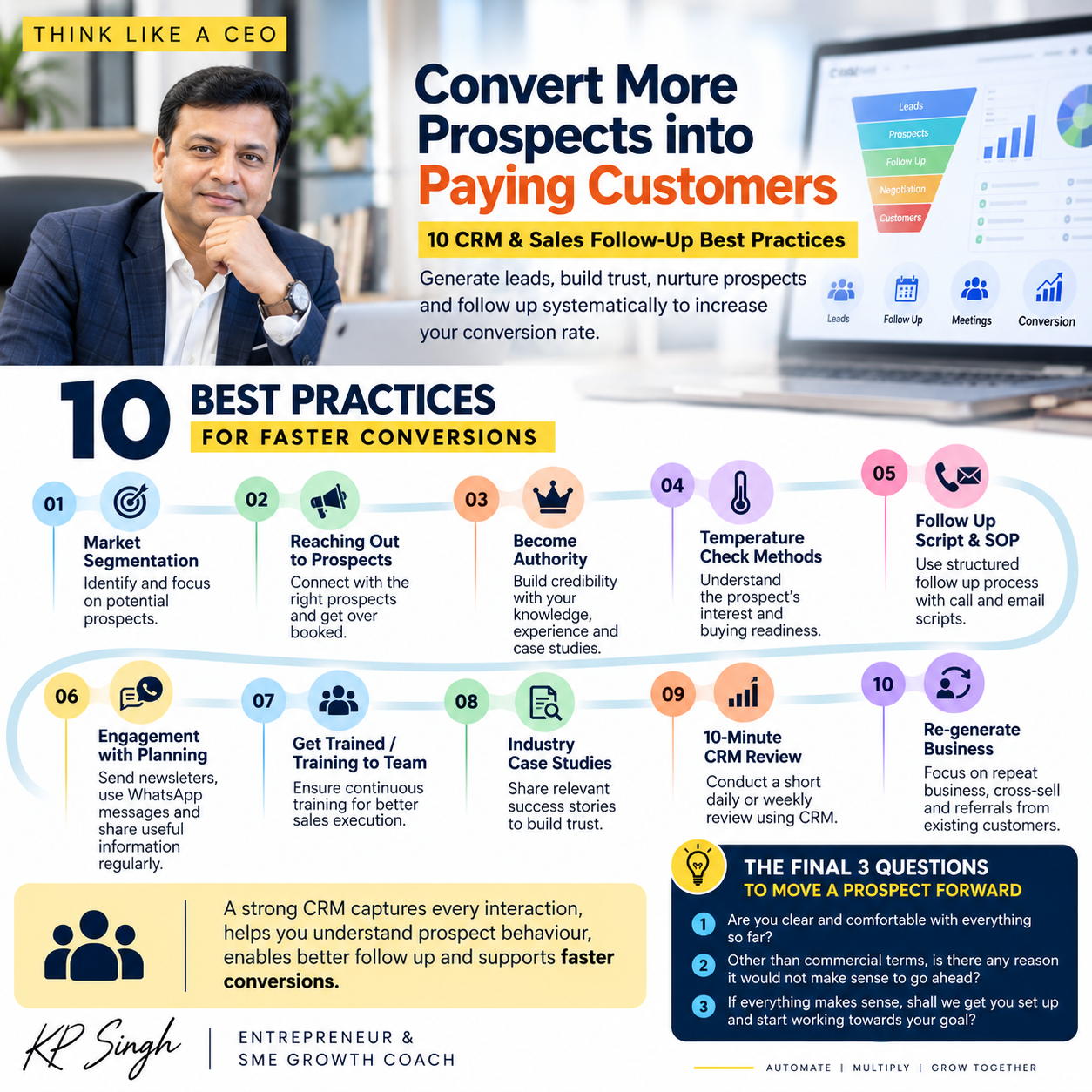
How to Convert More Prospects into Paying Customers: 10 CRM and Sales Follow-Up Best Practices
Thousands of potential customers may be looking for a solution like yours. But are you visible, credible, and valuable enough to be their first choice?
Every day, business owners invest time and money in generating leads through Google, Facebook, IndiaMART, Justdial, websites, referrals, and other channels. Yet many businesses struggle to convert those leads into paying customers.
Why?
Because generating leads is only the beginning. The real challenge is building trust, influencing buying decisions, nurturing prospects, and following up systematically until there is a clear outcome.
Your prospects may be willing to pay for the right solution. However, they will not necessarily choose you simply because your product or service is good. You must demonstrate why your offering is relevant, credible, and better suited to their needs.
Let's understand how to build a sales process that helps your business convert prospects faster and generate more revenue from both new and existing customers.
1. Become Influential Before You Try to Influence
Influencing a buying decision does not mean pressuring a prospect to buy. It means helping them understand their problem, evaluate available options, and confidently choose the right solution.
To become influential in your market, you need a deep understanding of:
Your products and services, including their benefits and limitations.
Your competitors' offerings, pricing, strengths, and weaknesses.
Your prospects' business challenges, priorities, and expectations.
The decision-making criteria your prospects use when selecting a vendor.
The risks, objections, and concerns that may prevent them from buying.
When you understand these factors, your sales conversations become more meaningful. Instead of merely pitching your product, you can connect your solution to the prospect's actual business needs.
Remember: Customers do not buy just because you want to sell. They buy when they see sufficient value, trust your capabilities, and believe your solution meets their requirements.
2. Build a Lead Funnel That Converts
Every business needs a structured lead funnel to move prospects from initial awareness to a buying decision.
A typical sales funnel includes:
Lead Generation: Attract potential customers through digital marketing, referrals, events, outbound calls, and other channels.
Lead Qualification: Identify prospects who have a relevant need, suitable budget, decision-making authority, and a realistic buying timeline.
Lead Nurturing: Educate prospects, address their concerns, share relevant information, and build trust.
Sales Conversion: Help qualified prospects evaluate the solution and make a confident buying decision.
Customer Growth: Retain existing customers, identify additional requirements, and generate repeat business and referrals.
Businesses often spend heavily on lead generation but fail to establish a consistent follow-up process.
A lead funnel should not end when a lead enters your CRM. It should continue until the prospect converts, is disqualified, or reaches a clearly documented outcome.
3. Use CRM to Build a Complete Prospect History
A strong Customer Relationship Management (CRM) system helps your sales team capture leads from multiple sources and manage every interaction in one place.
However, simply recording a prospect's name and phone number is not enough.
Your CRM should maintain a meaningful history of the relationship, including:
Lead source and date of acquisition.
Business requirements and identified pain points.
Call records, meeting notes, emails, and messages.
Product demonstrations, quotations, and proposals shared.
Objections raised and responses provided.
Follow-up commitments, responsible team members, and next actions.
Expected buying timeline and current sales stage.
Reasons for winning, losing, postponing, or disqualifying an opportunity.
This information helps salespeople understand a prospect's behaviour, avoid repetitive conversations, and choose the right next action.
It also enables managers to support their teams with facts rather than assumptions.
A CRM should tell you not only what happened with a prospect, but also what needs to happen next.
4. Warm Up Cold Leads Through Consistent Follow-Up
Not every prospect is ready to buy when they first contact your business.
Some are actively looking for a solution. Others are comparing vendors, gathering information, waiting for budget approval, or planning to buy several months later.
Your follow-up process should recognise these differences.
Use a structured lead-temperature system:
Cold: The prospect has shown limited interest or has not yet established a clear need.
Warm: The prospect has a relevant requirement and is engaging with your team.
Hot: The prospect has a strong need, is evaluating solutions seriously, and has a realistic buying timeline.
Sales-ready: The prospect has met your qualification criteria and is ready for a specific next step, such as commercial negotiation or onboarding.
These categories should be based on observable behaviour, not merely the salesperson's assumptions.
Plan follow-ups according to the prospect's interest, urgency, preferences, and agreed timeline. Avoid repeatedly contacting prospects without adding value.
5. Create a Follow-Up Script and SOP
Sales follow-up should not depend entirely on an individual salesperson's memory or personal style.
Develop a standard operating procedure (SOP) that explains how to handle different sales situations.
Your SOP should cover:
The first response after a new enquiry.
The discovery call and qualification questions.
Follow-up after a product demonstration.
Follow-up after sending a quotation or proposal.
Responses to common objections.
Re-engagement with prospects who have stopped responding.
Closing conversations and documenting the final outcome.
Prepare adaptable call and email scripts for each stage. The objective is not to make every salesperson sound identical; it is to ensure that every prospect receives a consistent, professional experience.
Every interaction should conclude with a clear next step, an agreed timeline where possible, and an updated CRM record.
6. Keep Prospects Engaged Through Planned Communication
A prospect who is not ready to buy today may become a customer in the future.
Instead of allowing such prospects to disappear from your sales pipeline, develop a planned engagement strategy.
Useful activities include:
Sharing educational newsletters and relevant industry updates.
Sending useful information through WhatsApp, with appropriate consent.
Publishing articles, videos, and practical business tips.
Sharing customer success stories and relevant case studies.
Inviting prospects to webinars, workshops, and product demonstrations.
Providing updates about features or solutions relevant to their requirements.
Every communication should have a purpose. Avoid sending repetitive promotional messages that offer no meaningful value.
The goal is to remain relevant and trustworthy until the prospect is ready to make a decision.
7. Train Your Sales Team Continuously
A CRM cannot compensate for a team that lacks product knowledge, communication skills, or sales discipline.
Your sales team should receive regular training in:
Product and service knowledge.
Industry-specific business challenges.
Competitor positioning.
Discovery questions and active listening.
Lead qualification and objection handling.
Negotiation and closing techniques.
CRM usage and follow-up discipline.
Use real sales conversations, lost opportunities, customer feedback, and successful deals as training material.
Managers should coach team members on actual opportunities rather than relying exclusively on general sales training.
The objective is to build a team that understands not just what to say, but why, when, and how to say it.
8. Use Industry-Specific Case Studies to Build Credibility
Prospects are more likely to trust your solution when they can see how it addresses challenges similar to their own.
Develop case studies that explain:
The customer's business situation before implementation.
The problem or challenge that needed to be solved.
The solution you recommended.
How the solution was implemented.
The measurable results achieved.
Lessons that other businesses can apply.
Whenever possible, use verified metrics and obtain permission before publishing customer information.
A case study relevant to the prospect's industry can be more persuasive than a generic product presentation because it connects your capabilities with a real business situation.
9. Conduct a 10-Minute Daily Sales Review Using CRM
Sales reviews do not always need to be long meetings. A focused 10-minute review can help managers identify priorities and remove obstacles.
Use the CRM as the single source of truth and review:
New leads received and their response status.
High-priority prospects requiring immediate action.
Follow-ups due or overdue.
Proposals awaiting a decision.
Deals that are stalled and the reasons behind them.
Support required from managers or other departments.
Next actions, owners, and deadlines.
Focus on exceptions, decisions, and commitments rather than asking every salesperson to narrate every activity.
Managers should use prospect history to guide their team members, resolve bottlenecks, and improve conversion quality.
The purpose of a sales review is not merely to check activity. It is to improve the probability of a positive sales outcome.
10. Generate More Business from Existing Customers
Your sales growth strategy should not focus exclusively on acquiring new customers.
Existing customers already know your business, have experienced your service, and may have additional requirements that you can address.
Build a systematic customer-growth process that includes:
Regular customer relationship reviews.
Customer satisfaction and feedback checks.
Identification of new needs and business opportunities.
Relevant cross-selling and upselling.
Contract renewal and service follow-up.
Referral requests when customers are satisfied.
Re-engagement with inactive or lost customers.
Do not assume that an existing customer will automatically return when they need something. Maintain the relationship, understand changing requirements, and provide value consistently.
Growing existing accounts can complement new customer acquisition and help improve the overall value of your customer base.
The Final Three Questions That Can Help Move a Qualified Prospect Forward
After you have understood the prospect's requirements, established credibility, demonstrated the solution, and addressed major concerns, use these three questions to check buying readiness.
Question 1: Confirm clarity
"Have I explained everything clearly so far? Are you comfortable with how the solution works, or is there anything you would like me to clarify?"
Question 2: Identify remaining objections
"Other than the commercial terms, is there anything else that might prevent you from moving forward with this solution?"
Question 3: Agree on the next step
"If everything meets your requirements, shall we discuss the next steps to get started and work towards your desired outcome?"
These questions are most effective when the prospect has demonstrated genuine interest and the conversation has reached an appropriate stage.
If concerns remain, address them honestly rather than pushing for an immediate commitment. If the prospect is ready, agree on the next action, its owner, and the expected timeline.
CRM Discipline Matters More Than CRM Installation
Many businesses implement CRM or ERP software expecting sales performance to improve automatically.
But software alone cannot create a disciplined sales culture.
Successful implementation requires:
Clearly defined sales processes.
Management commitment and consistent participation.
Training and adoption by every relevant team member.
Accurate and timely data entry.
Integration with other systems where it delivers real business value.
Regular reviews of process compliance and business outcomes.
CRM implementation and third-party integrations may take time depending on requirements, data quality, and technical complexity. The important thing is to follow a realistic implementation plan and ensure that the process is adopted throughout the organisation.
The business owner must lead by example. If managers and decision-makers bypass the system, the team will eventually do the same.
Conclusion: Build a Sales System, Not Just a Sales Team
Generating leads is important, but sustainable sales growth comes from what your business does after a lead arrives.
When you combine market segmentation, effective positioning, lead qualification, structured follow-up, CRM discipline, team training, and customer relationship management, you create a repeatable process for improving sales performance.
Review these ten practices every month. Identify what is working, where prospects are getting stuck, which activities are producing results, and what needs improvement.
Remember, not every lead will convert, and not every buying decision can be influenced. The objective is to improve the quality of your sales process, make better use of your opportunities, and reach a clear outcome with every qualified prospect.
Think Like a CEO. Build a disciplined sales process. Convert opportunities into lasting customer relationships.
KP Singh — Entrepreneur & SME Growth Coach
No comments found
Post your comment