How to Get Paid
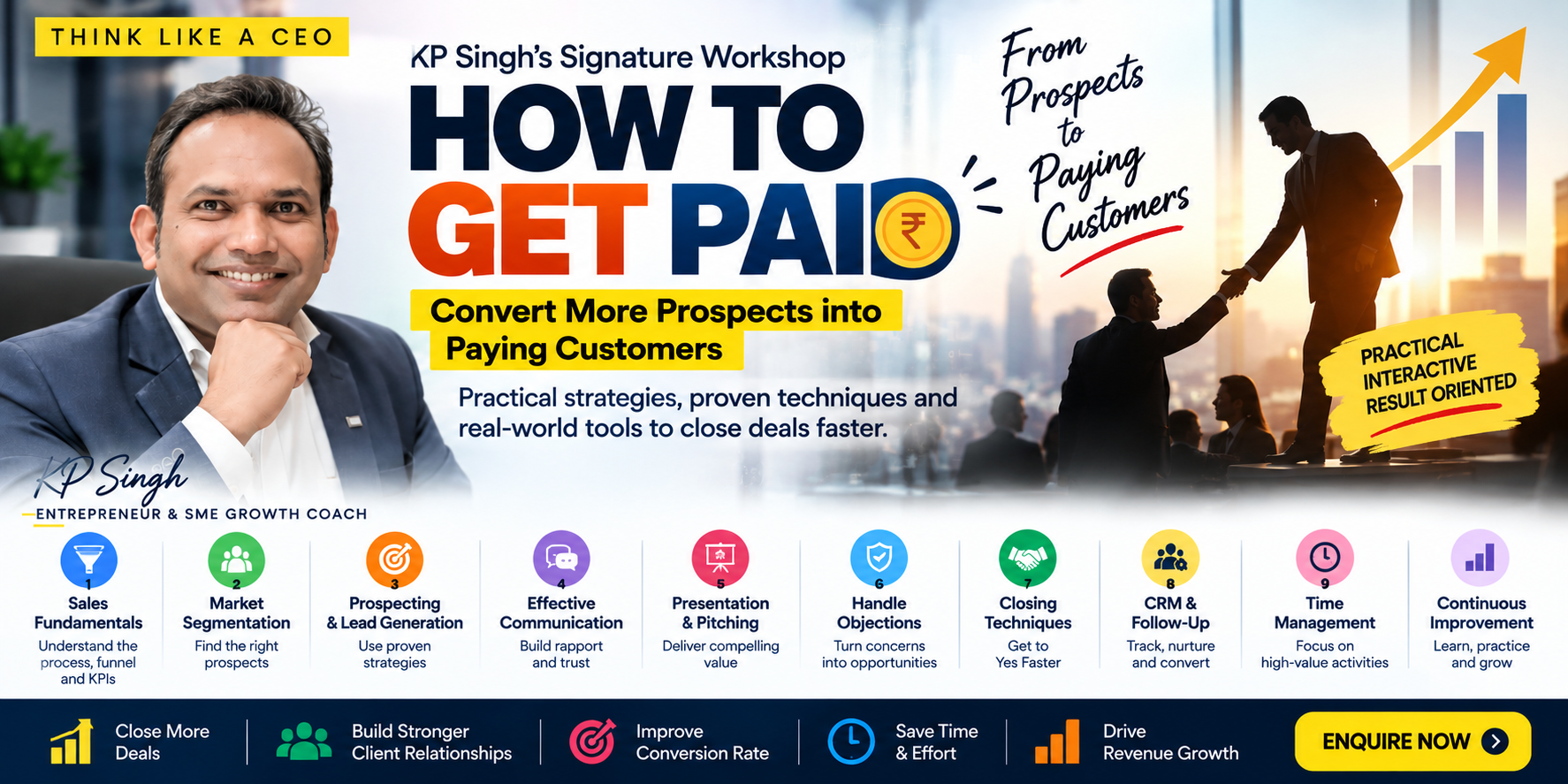
KP Singh’s Signature Sales Conversion Workshop
Convert More Prospects into Paying Customers. Close Deals with Confidence.
Generating leads is important. But the real success of a business lies in converting those leads into paying customers.
Many sales professionals and business owners spend considerable time generating enquiries, conducting meetings, preparing quotations, and following up with prospects. Yet deals remain pending, prospects stop responding, and sales opportunities are lost because the buying process is not managed effectively.
“How to Get Paid” is KP Singh’s signature sales conversion workshop designed to help sales professionals and business owners understand buyer behaviour, build credibility, handle objections, and move qualified prospects towards a buying decision more effectively.
The workshop presents practical techniques covering the complete sales journey—from market segmentation and prospecting to lead qualification, relationship building, follow-up, negotiation, and deal closure.
The objective is simple: Help you turn more sales conversations into clear buying decisions and paying customers.
What Will You Learn in the How to Get Paid Workshop?
1. Understand Sales Fundamentals
Build a strong foundation in the sales process, sales funnel, customer journey, and sales performance measurement.
Understand how prospects move from initial awareness to interest, evaluation, negotiation, and purchase—and identify where your business loses potential customers.
2. Market Segmentation, Prospecting and Lead Generation
Learn how to identify the right target audience instead of approaching every prospect with the same message.
Discover practical approaches to prospecting through cold calling, networking, email outreach, social selling, referrals, and digital channels.
Focus on prospects whose needs, budgets, priorities, and buying potential align with your offering.
3. Understand Buyer Behaviour and Build Credibility
Successful selling starts with understanding the customer.
Learn how to identify a prospect's business challenges, expectations, decision-making criteria, and concerns.
Develop the credibility required to influence buying decisions through product knowledge, industry understanding, relevant case studies, and a clear value proposition.
4. Master Effective Communication
Learn how to conduct meaningful sales conversations that build trust and uncover genuine requirements.
Develop skills in active listening, asking relevant questions, understanding customer priorities, and communicating value clearly.
The goal is not simply to speak persuasively. It is to help prospects understand how your solution addresses their needs.
5. Deliver Powerful Presentations and Sales Pitches
Learn to present your product or service in a way that connects with the prospect's priorities.
Structure your pitch around business problems, expected benefits, relevant evidence, and the value of taking action.
Replace feature-heavy presentations with customer-focused conversations that make it easier for prospects to evaluate your offering.
6. Handle Objections and Overcome Buying Resistance
Objections are a normal part of the buying process. They may relate to pricing, trust, timing, competing vendors, implementation, or perceived risk.
Learn to uncover the real concern behind an objection, respond with relevant information, and help prospects evaluate their options.
Instead of arguing with customers or immediately offering discounts, develop the ability to address concerns professionally and establish the value of your solution.
7. Master Follow-Up and CRM Discipline
Many sales opportunities are lost because follow-ups are inconsistent, poorly timed, or lack a clear purpose.
Learn how to create a structured follow-up process using calls, emails, meetings, and appropriate messaging channels.
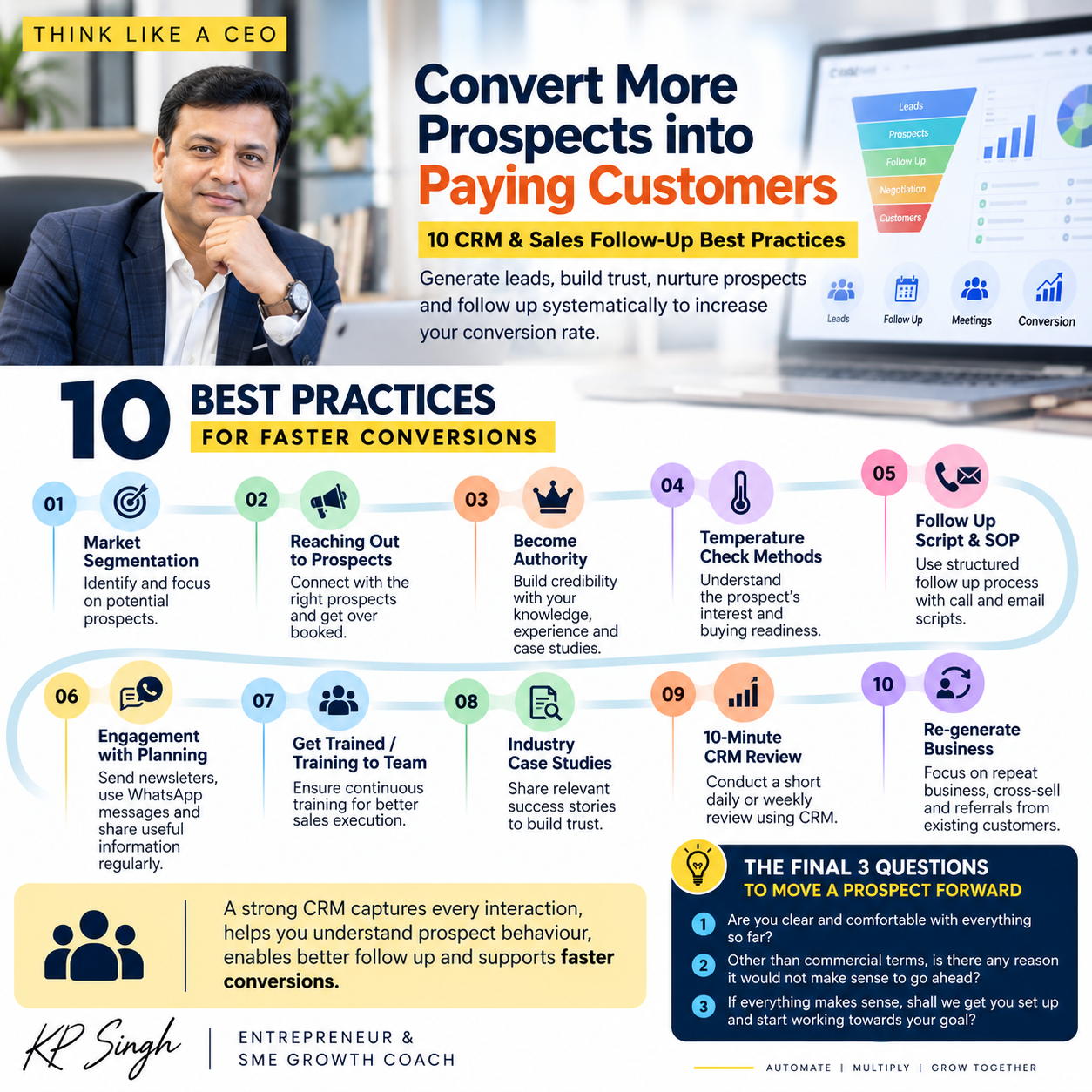
Understand how CRM systems can help you maintain conversation history, track lead temperature, schedule next actions, and identify opportunities that require attention.
Every meaningful interaction should move the sales process forward or help establish a clear outcome.
8. Learn Effective Deal-Closing Techniques
Closing is not about pressuring a prospect. It is about helping a qualified buyer make a confident decision when the solution meets their requirements.
Learn to recognize buying signals, confirm the prospect's understanding, identify unresolved concerns, and agree on the next step.
The workshop introduces practical closing questions, including:
Confirm clarity: “Are you clear and comfortable with everything we have discussed so far?”
Identify remaining objections: “Other than the commercial terms, is there any reason this solution would not make sense for your business?”
Agree on action: “If everything meets your requirements, shall we discuss the next steps to get started?”
These questions should be used when appropriate, after the prospect's requirements and concerns have been understood. The aim is to reach a clear decision—not to force an immediate commitment from someone who is not ready.
9. Improve Sales Productivity and Time Management
Sales success depends on how effectively you use your time and prioritize opportunities.
Learn to distinguish high-potential prospects from low-priority leads, organize daily sales activities, and focus on actions that move opportunities forward.
Use clear priorities, follow-up schedules, and pipeline reviews to reduce wasted effort and improve sales discipline.
10. Practice Through Role-Plays and Real Sales Scenarios
Knowledge becomes valuable when it can be applied in real conversations.
The workshop can include role-playing exercises, objection-handling scenarios, sales pitch practice, and deal-closing simulations.
Participants can practice responding to common customer situations, receive feedback, and improve their approach in a supportive learning environment.
11. Build a Culture of Continuous Sales Improvement
Sales performance improves when teams review their results, learn from lost opportunities, and consistently refine their approach.
Learn how to use sales KPIs, conversion rates, follow-up discipline, pipeline reviews, and customer feedback to identify improvement opportunities.
For business owners and sales managers, this also creates a foundation for coaching teams and strengthening sales execution.
Who Should Attend This Workshop?
The How to Get Paid workshop is designed for:
Business owners who want to improve sales conversion and revenue generation.
Sales professionals who want to become more confident and effective at closing deals.
Sales managers who want to build a disciplined, accountable sales team.
Entrepreneurs who generate enquiries but struggle to convert them consistently.
B2B sales teams dealing with long buying cycles, multiple decision-makers, and complex objections.
Service providers, consultants, distributors, and product businesses that depend on relationship-driven selling.
What Makes How to Get Paid Different?
The workshop focuses on the complete sales conversion process rather than isolated selling techniques.
Participants explore how market segmentation, buyer psychology, credibility, communication, follow-up discipline, CRM usage, and closing techniques work together.
The emphasis is on practical application: understanding what to do, when to do it, and how to improve the outcome of each sales interaction.
The workshop also reinforces an important principle: Sales conversion is not just the responsibility of an individual salesperson. It is the result of a well-designed sales process supported by the right people, tools, and management discipline.
About KP Singh
KP Singh is an entrepreneur and SME Growth Coach who helps business owners build stronger leadership, improve execution, establish business systems, and scale through structured processes and technology.
Through his Think Like a CEO philosophy and RTS Business Framework, he emphasizes the importance of clear goals, capable teams, accountability, and consistent execution.
The How to Get Paid workshop brings this practical, business-oriented approach to sales conversion—helping participants strengthen the way they identify prospects, build trust, manage opportunities, and move towards buying decisions.
What Outcomes Should Participants Aim For?
After applying the workshop's practices, participants should aim to:
Improve the quality of prospecting and lead qualification.
Communicate value more clearly.
Build stronger credibility with prospects.
Handle objections more effectively.
Maintain consistent follow-up and CRM records.
Identify stalled opportunities and agree on next steps.
Improve sales conversion through measurement and continuous practice.
Actual results depend on the participant's skills, market, offering, pricing, sales process, and implementation of the practices.
Ready to Improve Your Sales Conversion?
Stop relying only on more leads. Build a process that helps you convert the right prospects through trust, value, consistent follow-up, and confident closing.
Join KP Singh’s “How to Get Paid” Signature Sales Conversion Workshop and learn practical ways to strengthen your sales conversations and improve deal outcomes.
CTA: Enquire About the Workshop
Think Like a CEO. Sell with Confidence. Convert with Discipline.
No comments found
Post your comment